WordCamp Seattle!
I’m going to spend the day nerding out!
Examples of how technology has permeated every single bit of my life.
I’m going to spend the day nerding out!
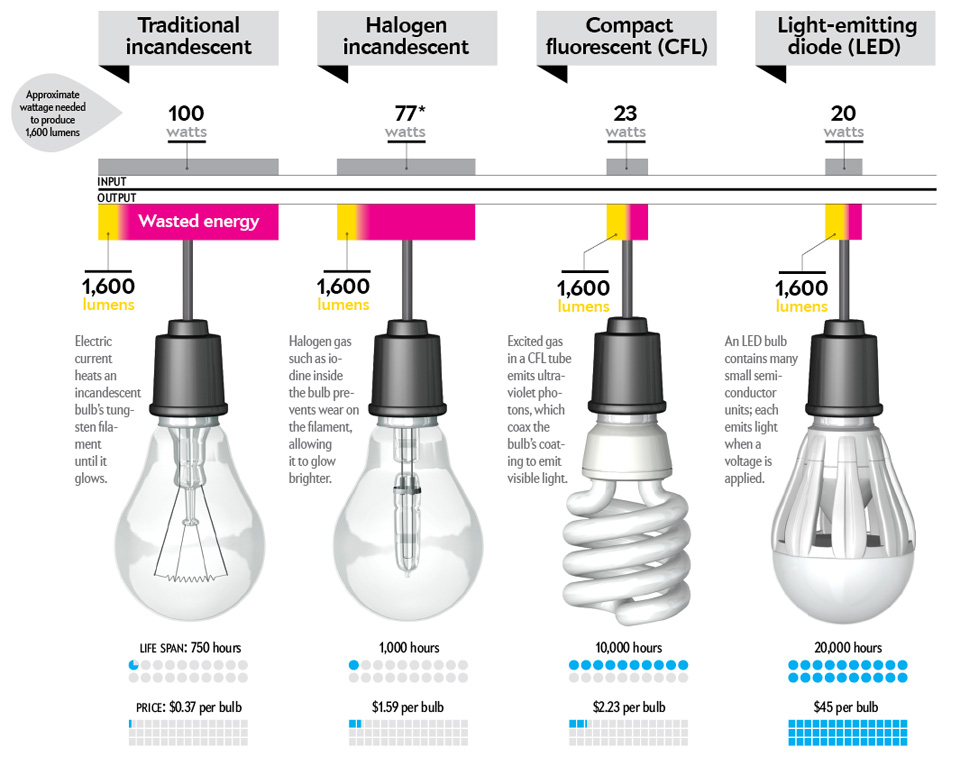
Scientific American had an article on the costs of light bulbs1. I wanted to figure out a way to fairly compare the rough lifecycle costs of the bulbs to the consumer. I figured the best way to do that would be to determine the cost per an operating lux-hour.
We’re going to figure out the cost to buy and operate lights that emits 1600 lumens for 20000 hours 

Traditional Incandescent
Cost of energy:
Cost of bulbs:
Total Cost:
You can do the same math for the rest of the bulbs (substituting the proper numbers in) to get a chart that looks like this:
| Traditional Incandescent |
Halogen Incandescent |
Compact Fluorescent (CFL) |
LED | |
|---|---|---|---|---|
| Watts (W) | 100 | 77 | 23 | 20 |
| Lumens (lm) | 1600 | 1600 | 1600 | 1600 |
| Cost/bulb | $0.37 | $1.59 | $2.23 | $45 |
| Life span (hours) | 750 | 1000 | 10000 | 20000 |
| W/lm | 0.0625 | 0.0481 | 0.0144 | 0.0125 |
| $/(lm-h) | 5.313E-06 | 4.091E-06 | 1.222E-06 | 1.063E-06 |
| Cost to run | $170.00 | $130.90 | $39.10 | $34.00 |
| $/h | 0.493E-04 | 1.590E-04 | 2.230E-04 | 2.250E-04 |
| Cost to buy | $9.87 | $31.80 | $4.46 | $45.00 |
| Total cost | $179.87 | $162.70 | $43.56 | $79.00 |
Here’s the thing I found amazing: there’s a big push to implement LEDs, probably because of the ‘cool’ factor. However, they don’t save that much more energy over CFL — about 13% — and they cost almost twice as much to operate right now. Manufacturers are going to have to have to drop the cost of LED lights a lot in order to make a change worth it…or the government will have to ban mercury in lights3.
Graphic by George Retseck and Jen Christiansen
Sources: U.S. Department of Energy and Efficacy calculations based on currently available bulbs (traditional, halogen and compact fluorescent); SWITCH LIGHTING (led)
How to Buy a Better Lightbulb, John Matson, Scientific American, January 6, 2012 ↩
CFLs contain about 4mg of Mg, per Energy Star ↩
The printer was hole-punching my printouts at work (on the wrong side of the page, to boot). I was mystified by why it was doing this.
I tried changing the print settings.
I tried restarting my computer.
I tried restarting the printer.
I tried uninstalling and reinstalling the printer driver.
I tried that rain dance I learned middle school.1
Nothing worked.
I went to call the help desk, expecting the agony of having to cater to their pedantic troubleshooting guide. I started to imagine what they might ask me, and began to mentally reply to their invisible questions, “Yes, I did that… Yes, I tried that… No, that didn’t work either.”
I was dreading the thought of another 30 minutes wasted. I decided to get one more data point by verifying with my coworker that he had the same issue.
His words of wisdom: “Oh, the printer must be loaded with the wrong paper again.”
“The wrong paper? Again?”, I thought to myself.
I quizzically walked back to the printer and furiously opened all the trays in an attempt to locate the non-compliant source.
And there it was. The paper punched for a three-ring binder.
I made this up, but I should have tried it ↩
I shared this video1 with Peter, who then asked:
I saw that a couple days ago. Awesome! And has some cool practical applications. I [couldn’t] quite tell if the pitch of the robot was adjustable by the user, or of it always jumped in the same direction. Did you get a sense for that?
It was a good question and one I didn’t have an immediate answer to.
I would actually guess that I don’t have immediate answers2 to at least 50% of questions people ask me3. I have to do some amount of thinking, and sometimes even some research. I think people tend to think I know the answer off the top of my head, I assure you: I am not that smart.
I do have an inquisitive mind, I do know where to look, and I do know how to ask the right question.

I decided to remedy this question though by talking it through, instead of just giving an answer. This is basically my thought processes as it occurred. Except that I got Sin and Cos mixed up and didn’t realize it until I had finished my conclusion. So I had to redo my entire analysis, and that’s what you see here. Please note this is still really just a paper napkin answer:
As far as angle, I’m not sure. I suspect there would be some angle change.
Elevation angle can affect two things, how high it goes and how far it goes forward, and these two things are intrinsically linked through SohCahToa. Height and forward distance can also be affected by the force applied (ceteris paribus4). This gives a problem with two independent input variables (angle and power) and two dependent output variables (height and forward distance/range).
Since my primary goal is to jump, I’m going to put most of my energy into that. If I want to jump higher, I can either apply more force or make my elevation angle higher (as long as it’s < 90°). As the elevation angle nears 90° [latex]\left (\frac{\pi}{2} \right )[/latex], more of my energy goes into going up than going forward. The proportion of energy applied to going up is defined by Sin and the proportion of energy applied to going forward is defined by Cos. Also worth remembering is that the Sin[x] + Cos[x] is not a straight line, it's another parabola that peaks at 45 degrees. The biggest bang for your average buck is to angle yourself at 45 degrees and shoot. Additionally, Cos (forward) angles that are near 90° have a high rate of change (i.e. going from 80° to 81° has more of a difference than going from 10° to 11°), thus little changes in elevation angles near 90° have relatively larger impacts on how far forward I go. Conversely, Sin (height) angles that are near 90° have very low rates of change. The cross over point for rates of change between Sin and Cos is - you guessed it - at 45° . Since the goal of the robot is to jump high (not far), it would make sense to only use high angles (above 45° ). To vary height significantly though, you are going to have vary power. Going from 46° to 90° only increases height by ~93% if the force remains the same. In comparison, going from 1 degree to 45 degrees increases height by 164,000%. Math is great, but if you can't implement it, it doesn't matter so let's turn to what's practical: One of the underlying assumptions is if the robot can vary the force it uses and if it could accurately set it's elevation angle. Setting the angle is pretty easy using encoders, and accelerometers to determine which way is down (if you were jumping from an angled surface, for instance). We've also already seen that the jumping leg can move, so adding functionality for precision angle measurements (within a degree, let's say) is pretty trivial. The real question, I think, is how does it jump? Delivering energy quickly has always been a problem. Delivering a measured amount of energy quickly even more so. Based on jumping from the ground to the loading dock (1.5 meters in height at most) and then from the loading dock to the roof (probably at least 4 meters), that's about a 166% increase in height, which is not quite enough as could be accomplished by just varying the angle from 46° to 90°. Since you can't gain that height just by altering the angle alone, it makes sense to assume that the jump force setting can be altered. However, if you change the jump force setting, what does that do to the forward movement (we know it will make the robot jump higher)? It will, of course, move the robot forward even more. How much more? I don't know exactly, but probably enough to make some minor angle tweakage worth it. We would have to sit down and work on the math to verify the exact amount. I think it involves something with squaring the derivative of the force divided by the mass. Squaring always make numbers bigger, so I tend to think it would be significant. Suffice it to say, if you don't want to proportionally more forward when you jump significantly higher, you would have to adjust your jump elevation angle. Thus I would assume there may be small changes in angle elevation, but that's hard to estimate given the view-point the videos were shot at. It's also pretty easy to solve for power required and angle needed to reach a particular height while moving forward only a certain amount (once you figure out what the maths are), so at least the implementation factor is pretty easy from a computing standpoint. And I've spent way to much time on that answer.5 As always, please check my work.
I’ve been busy with work, but I’ve been keeping my eye on the news. Politics have always been a bit…screwy. I’m not sure if they’re getting more screwier or I’m becoming more aware of what’s going on. – maybe just more cynical.
Representative Lamar Smith and Senator Patrick Leahy now joins the ranks of former Senator Ted Stevens1 in Internet Hall of Shame with his further bastardization of the copyright clause2 with their introduction of SOPA and PIPA
I’ve long rallied against the MPAA, RIAA, and their cronies, and for copyright reform (see here, here, here, here, here, here, and here).
SOPA/PIPA is yet another horrible piece of legislation in a growing list of legislation unscrupulously backed by large corporations, and the Supreme Courts expansion of “corporate personhood” in Citizens United v. Federal Election Commission doesn’t help either.
It expands the reach of copyright in ways that are detrimental to the very purpose of the copyrights, in particular by hindering the promotion of useful arts. And all this is done at the behest of corporations who, essentially, bribe politicians.
Even more unfortunate, the politicians writing these pieces of legislation — or at least responsible for introducing them, I have no idea if they actually write them — have no idea of the technical ramifications of what they are doing. Would you trust your Congressman to perform surgery on you? There are actually 18 medical doctors3, so you have about a 3.4% chance of standing a chance, but I think in general the answer would be no.
When it comes to technical issues though, of the 535 members of congress, one is a physicist, one is a chemist, six are engineers, and one is a microbiologist4. This is not to say that other members of congress may not be tech savvy, but with the average age of a congressman pushing 60, I’m guessing not so much. Of the 12 original co-sponsors of SOPA, not one has a technical background.
Surely the United States House Science Subcommittee on Technology and Innovation, the subcommittee through with SOPA passed, has some technical experts. Nope. Not a single engineer or anyone with experience (as far as I could tell) in computer science. I would expect that people making the such decisions have, you know, actual expertise in those areas — a technocracy.
Anyway, I have poked around the SOPA legislation, and read many different analysis on it. I also do have an engineering degree. And so I feel very confident in saying that SOPA/PIPA is a bad idea from a technological standpoint. I also think’s it’s pretty bad from an overbearing-copyright standpoint, but that’s my personal bias.
In response to what SOPA/PIPA will do to the Internet if passed, I am joining other sites5 to protest SOPA and PIPA and will black out AFdN for all of Wednesday, January 18th, 2012. Any attempts to access AFdN will result in a HTTP 503 Service Unavailable error.
Seriously though, if SOPA/PIPA passes, I may have to take down AFdN lest I avoid getting sued. That’s a bridge I hope to never have to cross. In the meantime, take some time to educate yourself on how the internet works. Ask questions and I’ll try to answer them. And maybe, just maybe, we can make a difference.
Also, while I currently use GoDaddy as my domain name registrar, they supported SOPA and thus I will no longer support them. I’ll have another post on that in the future.
Some, but not all, interesting links:
Everything is a Remix
SOPA Infographic
House takes Senate’s bad Internet censorship bill, tries making it worse
Contact your congressman
Sopa 101: a guide to the USA’s proposed anti-piracy legislation
IP Law Wiki
Stanford Law Review: Don’t Break the Internet
Shit, I used Wikipedia about ten times to look up references for this post. Oh well, see you all Thursday!
“And again, the Internet is not something that you just dump something on. It’s not a big truck. It’s a series of tubes.” ↩
Article I, Section 8, Clause 8 of the United States Constitution: “To promote the Progress of Science and useful Arts, by securing for limited Times to Authors and Inventors the exclusive Right to their respective Writings and Discoveries.” ↩
such as Wikipedia, WordPress, reddit, Google, and BoingBoing ↩
I met Rachel’s friend from college, Laura. Laura has the awesome job of being a researcher at MSU in their ICAL (Imaging and Chemical Analysis Laboratory). Of particular interest was Laura’s job of operating the scanning electron microscope!
So of course I asked if we could have a tour! Not only did we get a tour, Laura even let me operate the machine! Oh yes folks, I got to operate a scanning electron microscope!
The first we used was the Zeiss SUPRA 55VP Field Emission Scanning Electron Microscope providing ultra high-resolution at low kV with resolutions of 1.7nm1 at 1.0kV2. Laura had a spider sample prepared and so we decided to use that. Here are some of the pictures I took:


We also got to use the JEOL JSM-6100 Scanning Electron Microscope, which is quite a bit older, but just as cool.
It works a bit different from the FM-SEM, using Secondary Electron Imaging (SEI) and Backscattered Electron Imaging (BEI). Rachel has a stainless steel ring she likes to wear, so we through that in and took a look at it under the scope:


I was pretty much like a kid in a candy store. I had an awesome time and got to add a new item to my Christmas list for next year.
I gave up Facebook and Twitter for Lent.
Well, I gave up most of Facebook1 and Twitter for Lent. I’m allowing myself five minutes of time on Facebook and Twitter each day (total for the both of them, and no rollover minutes). And even then, the only reason I’m doing that is because there are still some critical communications and event planning that occur through them. I don’t want to be completely antisocial, you know. I also want to be able to respond to @ reply’s on Twitter. So the five minute limit is really just designed so I can get in, do what I need to do, and get out.
I figured this was a good thing to give up for Lent because I found myself constantly checking Facebook and Twitter even when I had no good reason to. Basically, if I was bored or didn’t have anything fun to do (which should not be confused with not having anything to do) I would check those sites. The most annoying thing was that I found myself doing that the first thing in the morning while eating breakfast. I would sit there in my pajamas, eating my cereal, scrolling through the Facebook updates with one finger on my Android phone.
And so it was.
Yesterday, I went to Costco to get some supplies and made a somewhat big-for-me purchase (it was $50…not that big I suppose, but still). I got home and broke my new toy out of its packaging and thought about posting something witty about it on Twitter. I started thinking about what I could say in 140 characters or less.
Then I remembered that I couldn’t. Because I gave it up for Lent2. I actually kind of felt sad! That’s when I knew that giving up Twitter was probably a good idea.
I also think Twitter — and even Facebook to some degree — have contributed to my lack of posting here. Why write out 300, or 750, or even 1500 words on something when I can be lazy and write 140 characters?
This brings me to by big announcement: I bought a paper shredder, which makes me feel like an adult. But oh how I like to shred!3
Now, the whole irony of this thing is that new posts on my blog get automatically tweeted to Twitter, and then pushed to Facebook. But that’s pretty much the only activity you’re going to see from me on Facebook and Twitter until April 24th.
Anyone else give anything up?
which is quite incredible considering that just give years ago I passed up on giving up Facebook for Lent because “I’m really not that into Facebook (I might check it every three days or so)“…Facebook, you time sucking bastard. ↩
who’s silly idea was that? ↩
90 characters ↩
In roughly this order:
Photo by Matt Sizer ↩
Back In The Day™ I went to college with a kid named Lance Atkins. We shared many interests, including eating spaghetti every other Wednesday night. We were also lab partners in Machine Design, “an introduction to the principles of mechanical design [where m]ethods for determining static, fatigue and surface failure are presented.”1 We had fun. And we then we graduated. Lance declared his retirement from engineering and then went off to go fly planes — which I find interesting considering I work for an aerospace company and which Lance blames on Top Gun.
Then Lance had a crazy idea:
What do you want most? Start a business? That pretty girl on the subway? Ride a wild ostrich? Believe you want it and do it. We promise, the freedom is wonderful.
As Lance noted though, “…There is one caveat to your dreams, though. You have to risk that which you fear most: failure. So we set before you our risk. We have been working so, so hard to perfection. There are jobs that have been quit, money invested, and a few cuts and criticisms along the way.”2

And thus was born BlackBox Case, a better, stronger kind of protection for MacBooks, and “a product of curiosity, experimenting, and the hard work and obsession of some friends.”3
Andrew: First things first, I remember a very distinct comment from you the day after graduation where you declared that you had retired from engineering (having just graduated with a Bachelors in Engineering, Mechanical Specialty). Does this mean you’ve come out of retirement?
Lance: Aha! You may have caught me… I definitely am using my engineering skills. I’ve always been a builder, so I guess Blackbox Case is a natural extension of that. I enjoy that I get to be an artisan, craftsman and businessman, as well as engineer. Variety is the spice of life, you know.
There have been a variety of cases for MacBooks: neoprene sleeves, hard-shell plastic coverings, shoulder backs. Your case seems pretty unique, though maybe not the first to use wood; what was the motivation to create a different kind of case and what sets this case apart from the rest?
My laptops have always had a rough life. I just hated how they would get abused and develop cracks after a year of traveling around in a backpack. So I guess the idea started with a hardshell case that could isolate the laptop from that compression abuse. The next priorities were light weight and aesthetics. I checked into many materials, costs, and even did some finite element analysis to calculate what it would take to protect a computer from everyday life. I ended up being pleasantly surprised by wood, specifically oak, and it’s perfect properties. It’s stiff, light, and hard but not brittle. As a bonus, it’s pretty darn cool looking.

Is this case just for show or does it actually provide protection? What happens if I drop the case with my MacBook inside?
I’ve already talked about the “crush” protection it provides in a bag. We also expect a MacBook to survive a drop much better inside of a Blackbox Case. The case may be harmed, but a bicycle helmet breaks to protect your head, too.
Right now, the only way to get a BlackBox Case is through BlackBoxCase.com. Do you have plans to expand your distribution channels? Might we see the BlackBox in the Apple Store (online or brick and mortar)?
For now, we will sell only online. We may go retail in the future, but for now we are most concerned with turning out really amazing handmade MacBook Pro cases. We have a few tricks up our sleeve too. New products, new materials, you never know…

BlackBox Cases are currently made in Golden, Colorado, which I’m sure has an effect on the price. Will BlackBox Cases always be made in America?
Yep. We wouldn’t have started it here if it won’t stay here. I love the idea of employing local and buying local. I love designing products and the smell of sawdust, so I think we shall keep it that way.
15 Percent, that’s an awesome idea, one which I really like…almost more than the case itself. Tell us a little more about 15 Percent and what you hope to accomplish with it?
I think giving is, for me, a great way to let go of something I hold onto too tightly. It has the opportunity to do some creative good in this world too. We are challenging everyone to give us feedback about where the money should go, because we want this to be a community effort. What do I hope to accomplish? If we are to dream big, I want to give away $100,000. I don’t know where yet, that’s where you readers come in. I’ve done a lot of studying on the side effects of big money donation, so we seek to give to programs that are set up with wisdom and sustainability. Maybe you know someone who needs a hand up?4
Who else is on Team BlackBox? What’s their story?
My main man is Anthony. He was formerly a professional hardwood floor guy. He’s the chief of production. Austin used to work construction and is a web developer. We have also teamed up with some old friends to make this happen. Evan is a graphic designer, Mike is a business guru, and AK is a videographer. I have been really surprised at all the help and counsel we have gotten from other people. They’re coming out of the woodwork! (pun?) We’re having fun and learning a thousand things a day.
Oh, awesome — I love Anthony, he’s a good guy! Lance, thanks so much for sharing about BlackBox Cases, hopefully I can stop by next time I’m in town (some guy I know is getting married). And while I don’t have a MacBook (yet), you can bet I’ll be talking with you when I do get one.

I’ll drool over some new toy I’d love to have from time to time, but I’m not usually one to let my impulses get the best of me in that regard. However, Nikon’s new DSLR camera, the rumored D7000, could be one of those things I just have to get.
I’ve had my D70 for about 5 years now and it has served my very faithfully. 38,000 shutter clicks later and countless tens of thousands of miles traveled, my camera has done well and probably still has some spunk left in it.
However, I’ve found myself approaching the maximum technical capabilities of my current camera. My biggest need right now is more sensor sensitivity (ISO). My D70 tops out at 1600 ISO, which is not bad, but can produce some banding:
[flickr]212516062[/flickr]
The theoretical D7000 goes to ISO 25600, which is 16 times higher and allows for an additional four stops to work with. This is huge. I had to brace myself against a wall to get that photo in Florence, and even then I was still shooting at 1/50. If I were to shoot at ISO 25600, I could have shot it at 1/800. That’s insane.
The other awesome thing is how much better the quality is at a given ISO. Check out these sample images from Ken Rockwell showing the Nikon D70 (which is what I have), the Nikon D3 (which is a Nikon camera that can actually go to ISO 25600, but it probably not very representative of the D7000), and the Nikon D300S (which is probably more similar to the D7000 than the D3). The important thing to note is not the overall quality of these images (they are cropped really small), but the difference in image quality between ISO levels of a particular camera:

http://www.kenrockwell.com/tech/dslr-comparison/us.htm
http://www.kenrockwell.com/tech/dslr-comparison/us.htm

http://www.kenrockwell.com/nikon/d5000/high-iso-comparison.htm
http://www.kenrockwell.com/nikon/d5000/high-iso-comparison.htm
http://www.kenrockwell.com/nikon/d5000/high-iso-comparison.htm

http://kenrockwell.com/tech/comparisons/2010-08-03-5d2-7d-5d-d300/
http://kenrockwell.com/tech/comparisons/2010-08-03-5d2-7d-5d-d300/
The other big thing I’m looking forward to do is shoot amazing video montages. Similar to this:
Haiti Earthquake Aftermath Montage from Khalid Mohtaseb on Vimeo.

http://imaging.nikon.com/products/imaging/lineup/d90/en/advanced-function/
The downside is that each image is 2.5 times the file size of my D70, which is going to wreck havoc on my storage. I’ve never really had an issue blowing photos up and currently have a 30″ x 20″ hanging on the wall which looks just spectacular.
Anyway, here are the key differences that I’m interested in:
| D7000 | D70 | |
| Megapixel | 16.2 | 6.24 |
| Video | 1080P @ 24FPS | N/A |
| ISO, min | 100 | 200 |
| ISO, max | 25600 | 1600 |
| Auto Focus Points | 39 | 5 |
Hopefully, come September 15th, I may actually be able to plunk down some cash for this baby. Anyone interested in a well-loved, well-traveled, well-used Nikon D70? I’m going to go get a mop to wipe up all this drool.


