I think I just reached that magical threshold wher…
I think I just reached that magical threshold where many of my friends are having babies and I’m sorta freaking out about it because it means I’m definitely getting older.
I think I just reached that magical threshold where many of my friends are having babies and I’m sorta freaking out about it because it means I’m definitely getting older.
“A manifold equipped with a metric tensor is known as a Riemannian manifold.”1
Don’t ask why I’m reading about metric tensors if you don’t know what it is. If you do know what it is, please explain it to me like I’m 5 years old. ↩
One of the many things I like about Neil is how he parses a high level idea into separate parts. For Neil, education is more than just presenting the truth.
Being an educator means that you have to teach the truth, but you can’t just shove information on to people and say, “Here you go and if you don’t get it, too bad because it’s the truth.”
There is an art of persuasion involved which includes being sensitive to the students state of mind. You can’t just dump data on them, you have to combine the truth with how the student is receiving the information and adjust your delivery mechanism to create a lasting impact.
Likewise, you can’t be solely sensitive to the students state of mind. If they become upset when you talk to them about dinosaurs, that doesn’t mean you don’t teach them about dinosaurs. It doesn’t mean that you stop talking about dinosaurs. It doesn’t even mean that you stop acknowledging the existence of dinosaurs. It means that you find a way to teach them about dinosaurs while also acknowledging the reason they become upset to begin with1.
And to do that, you have to understand what’s already in their head and how those ideas got there. Teaching is about bringing facts and external sensitivity together to have impact. This is powerful stuff and a great lesson for everyone.
Richard Dawkins “gratefully accept[ed] the rebuke” of Neil and then goes on to provide this hilarious quote from an editor at New Scientist that I think goes to show why sensitivity is important.
The editor, when asked, “What is your philosophy at New Scientist?” replied, “Science is interesting and if you don’t agree you can fuck off.”
Feel free to replace “dinosaurs” with any other topic, such as evolution ↩
I was at a wedding over the weekend for some friends. During dinner, there was a trivia game and each table (ours was a table of five UPC folk) were able to submit their own questions for round :
Round two was an entire section on wedding trivia — who knew weddings cost so much and people married so late in life. This one in particular stood out for the comment delivered with such comedic timing half a beat later:
“In the phrase ‘Something old, something new, something borrowed, something blue,’ what does blue signify?” (half-beat) “Balls.”
The correct answer is actually purity, love, and fidelity3. I liked the first answer better — which also indicates that I’m apparently still 12 years old.
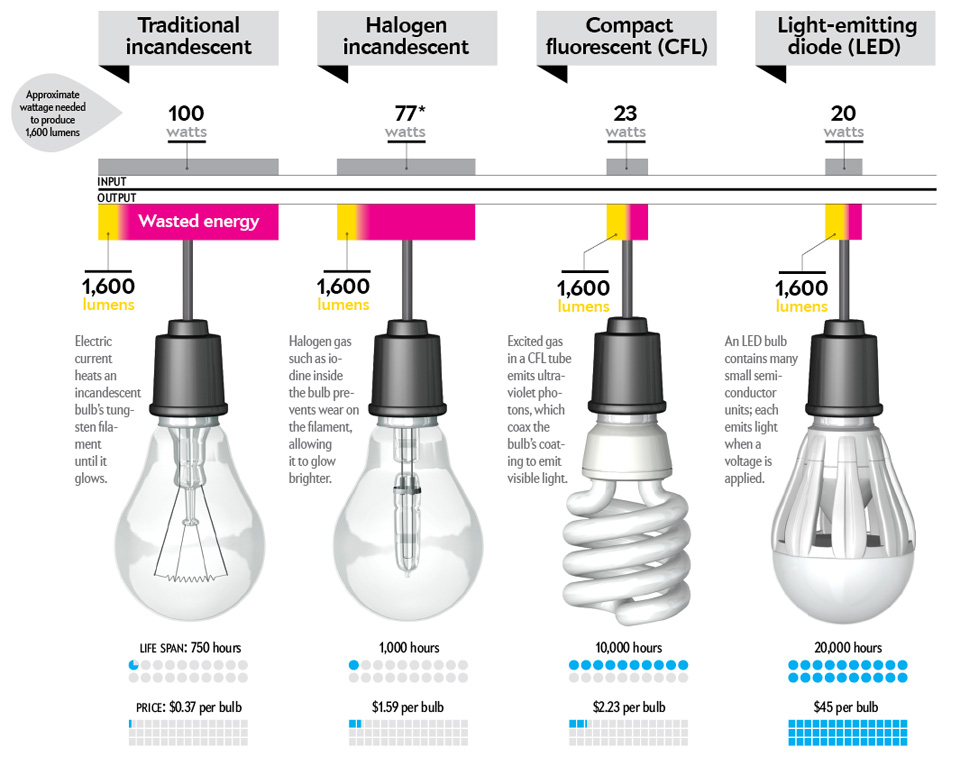
Scientific American had an article on the costs of light bulbs1. I wanted to figure out a way to fairly compare the rough lifecycle costs of the bulbs to the consumer. I figured the best way to do that would be to determine the cost per an operating lux-hour.
We’re going to figure out the cost to buy and operate lights that emits 1600 lumens for 20000 hours 

Traditional Incandescent
Cost of energy:
Cost of bulbs:
Total Cost:
You can do the same math for the rest of the bulbs (substituting the proper numbers in) to get a chart that looks like this:
| Traditional Incandescent |
Halogen Incandescent |
Compact Fluorescent (CFL) |
LED | |
|---|---|---|---|---|
| Watts (W) | 100 | 77 | 23 | 20 |
| Lumens (lm) | 1600 | 1600 | 1600 | 1600 |
| Cost/bulb | $0.37 | $1.59 | $2.23 | $45 |
| Life span (hours) | 750 | 1000 | 10000 | 20000 |
| W/lm | 0.0625 | 0.0481 | 0.0144 | 0.0125 |
| $/(lm-h) | 5.313E-06 | 4.091E-06 | 1.222E-06 | 1.063E-06 |
| Cost to run | $170.00 | $130.90 | $39.10 | $34.00 |
| $/h | 0.493E-04 | 1.590E-04 | 2.230E-04 | 2.250E-04 |
| Cost to buy | $9.87 | $31.80 | $4.46 | $45.00 |
| Total cost | $179.87 | $162.70 | $43.56 | $79.00 |
Here’s the thing I found amazing: there’s a big push to implement LEDs, probably because of the ‘cool’ factor. However, they don’t save that much more energy over CFL — about 13% — and they cost almost twice as much to operate right now. Manufacturers are going to have to have to drop the cost of LED lights a lot in order to make a change worth it…or the government will have to ban mercury in lights3.
Graphic by George Retseck and Jen Christiansen
Sources: U.S. Department of Energy and Efficacy calculations based on currently available bulbs (traditional, halogen and compact fluorescent); SWITCH LIGHTING (led)
How to Buy a Better Lightbulb, John Matson, Scientific American, January 6, 2012 ↩
CFLs contain about 4mg of Mg, per Energy Star ↩
I’m cleaning up my room and came across this note. I wrote it a few months ago as I was doing my planning for 2012.
For 2011, my word was “Pace“. This year, I picked four words about how I’m going to approach this year: Explore, Focus, Finish, Fun.
I didn’t just pick these four words out of thing air, there was a process to get there and this piece of paper was my thought process. Click to embiggen.

@rands To err is human; to check is engineering.
The printer was hole-punching my printouts at work (on the wrong side of the page, to boot). I was mystified by why it was doing this.
I tried changing the print settings.
I tried restarting my computer.
I tried restarting the printer.
I tried uninstalling and reinstalling the printer driver.
I tried that rain dance I learned middle school.1
Nothing worked.
I went to call the help desk, expecting the agony of having to cater to their pedantic troubleshooting guide. I started to imagine what they might ask me, and began to mentally reply to their invisible questions, “Yes, I did that… Yes, I tried that… No, that didn’t work either.”
I was dreading the thought of another 30 minutes wasted. I decided to get one more data point by verifying with my coworker that he had the same issue.
His words of wisdom: “Oh, the printer must be loaded with the wrong paper again.”
“The wrong paper? Again?”, I thought to myself.
I quizzically walked back to the printer and furiously opened all the trays in an attempt to locate the non-compliant source.
And there it was. The paper punched for a three-ring binder.
I made this up, but I should have tried it ↩
Rachel’s grandmother passed away last week, so we’re making the trek to Montana for the funeral service. We were going to visit Portland this weekend, but that trip has been preempted by this.
Since the funeral isn’t until Monday, we decided to inject some fun and take the train to Montana and then fly back.
We’ve never ridden on a train for travel, except when I was in Europe. So this will be a first for both of us in the US, which Rachel calls Darjeeling Limited-style.
The train ride takes 23 hours, so I’m hoping to provide some updates en route.
Cheers!
[flickr]6932078754[/flickr]
Free booze? Yes please!


